
Testing & Performance
Barracuda has been rigorously independently tested to ensure that it provides high levels of façade performance across watertightness, wind resistance, impact resistance, durability and temporary unmortared conditions.
This page brings together the key areas of Barracuda testing and performance in one place. It is intended as a clear starting point for specifiers, façade consultants, contractors and project teams reviewing the system.
Use the sections below to explore the main areas of evidence, or go straight to the supporting documents and downloads.
How the Barracuda Slip System works
Barracuda has been tested for watertightness under both static and dynamic pressure conditions.
Static pressure
Test method: CWCT Standard Test Methods for Building Envelopes: 2005 / BS EN 12154:2000
Classification / declared value: R7 / 600 pascals
Result: Pass
Controlled dismantle: Pass
Dynamic
Test method: CWCT Standard Test Methods for Building Envelopes: 2005
Classification / declared value: 600 pascals
Result: Pass
Controlled dismantle: Pass
Why it matters
PASS
Barracuda has been tested for both serviceability and safety performance.
Serviceability
Test method: CWCT Standard Test Methods for Building Envelopes: 2005 / BS EN 13116:2001
Classification / declared value: +2400 pascals
Result: Pass
Safety
Test method: CWCT Standard Test Methods for Building Envelopes: 2005 / BS EN 13116:2001
Classification / declared value: +3600 pascals
Result: Pass
Controlled dismantle: Pass
Why it matters
PASS
Barracuda has been tested for soft body and hard body impact in both serviceability and safety conditions.
Soft body serviceability
Classification / declared value: Class 1 / 120J
Result: Pass
Soft body safety
Classification / declared value: Negligible Risk / 350J and 500J
Result: Pass
Hard body serviceability
Classification / declared value: Class 1 / 3J, 6J and 10J
Result: Pass
Hard body safety
Classification / declared value: Negligible Risk / 3J and 10J
Result: Pass
Why it matters
PASS
Barracuda has undergone a full durability test sequence including heat/rain cycling, freeze/thaw cycling, cyclic wind load and impact testing.
Heat/rain
The test panel was subjected to 100 heat/rain cycles.
Freeze/thaw
The same test panel was then subjected to 100 freeze/thaw cycles.
Cyclic wind load
The same test panel was then subjected to 7681 wind load cycles, representing 60 years of natural wind exposure.
Impact testing after durability sequence
Following the full sequence, the same sample was subjected to further impact testing and remained both serviceable and safe, with no visible damage to the panel from a viewing distance of 1 metre.
Result: Long-term durability = Pass
Controlled dismantle: Pass
Why it matters
PASS
Traditional brickwork is mortared as it is laid. With brick slip systems, slips are typically fitted before being mortared. This means there can be a temporary unmortared state on site. Barracuda has been tested to demonstrate safe performance during this stage.
Brick slip pull-out testing
Brick slips ranging in height from 58 mm to 70 mm were required to resist a pull-out load of 100N per brick.
Result: Pass
Unmortared soft body safety
Classification / declared value: Negligible Risk / 500J
Result: Pass
Unmortared hard body safety
Classification / declared value: Low Risk / 10J
Result: Pass
Why it matters
This is particularly important because many systems are vulnerable before mortar is applied. Barracuda testing demonstrates performance during that temporary installation phase.
PASS
Barracuda test panels incorporated brick slips representing the full brick slip height tolerance range in which bricks compliant with BS EN 771 might be supplied. Testing demonstrated performance with brick slips ranging in height from 58 mm to 70 mm.
Most brick slip systems rely heavily on tight brick height tolerances for safe engagement. Barracuda was developed to accommodate real-world variation more effectively.
Why it matters
Featured documents
- Model Performance Specification
- Summary of Key Findings
- Evaluation Report
- Barracuda Specification

Fire performance
The Barracuda system is comprised of just two material types; stainless steel and aluminium. Both of these materials are entirely non-combustible and are A1 rated.
The British and European standard that covers the combustibility classification of construction products is:
- BS EN 13501-1:2018 Fire classification of construction products and building elements – Part 1: Classification using data from reaction to fire tests.
- BS EN 13501-1:2018 refers to some material types which have such well-established non-combustibility that they have been included in a list drawn up by the European Commission which confirms that they are all A1 Non-Combustible without the need for further test.
This list is specific to construction products and is annexed to European Commission Decision 96/603/EC.
The two other material types most immediately associated with the Barracuda system, bricks and mortar, are also on this list.
The Barracuda Brick Slip System has been classified A1, in accordance with BS EN 13501-1:2018, by UKAS-accredited reaction-to-fire testing specialists System Laboratories UK.
Cavity barriers
In the Barracuda brick slip cladding system, horizontal open-state fire barriers play a critical role in maintaining fire safety while allowing ventilation and drainage within the cavity behind the cladding.
These barriers are typically installed at key compartment lines, such as floor levels, and remain open under normal conditions to support airflow. In the event of a fire, the intumescent material within the barrier rapidly expands when exposed to heat, sealing the cavity and preventing the spread of fire and smoke through the void.
SIDERISE has carried out testing in accordance with the principles of TGD19 (prEN 1364-6) to verify the suitability of the RH25 90/30 open-state cavity barrier for use within the Barracuda system, accommodating cavity widths from 26 mm to 425 mm.
Vertical fire barriers are installed at regular intervals, typically at specific points such as building corners, window openings or where changes in elevation occur.
SIDERISE has carried out testing in accordance with the principles of EN 1366-4 to verify the suitability of the RV 90/30 cavity barrier for use within the Barracuda system, accommodating cavity widths from 26 mm to 425 mm.
All cavity barriers are to be installed strictly in accordance with the guidelines provided by SIDERISE.
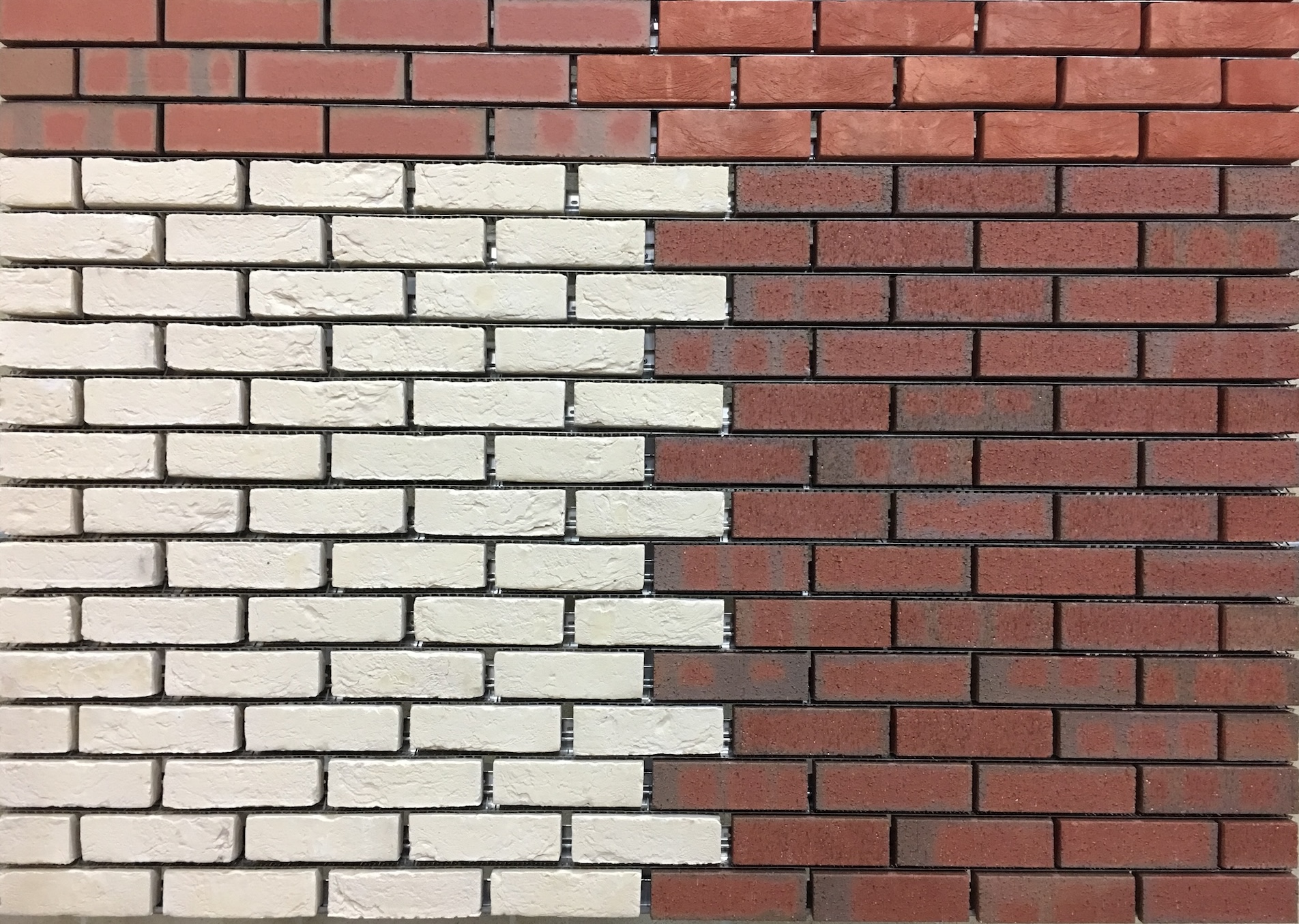
The Barracuda Brick Slip System has been granted patents in the UK, EU, USA, Canada and Australia.
Independent testing
The Barracuda system has been rigorously independently tested to ensure that it provides the very highest levels of performance.
In all cases the minimum test-panel size is 3 m high x 3.6 m wide, with a backing-wall construction that exhibits deflections equal to or exceeding those likely to be encountered on most actual project constructions.
Barracuda test panels incorporate brick slips that represent the full brick-slip height tolerance range in which bricks compliant with BS EN 771 might be supplied.
Testing demonstrates that the Barracuda brick slip system achieves its exceptional performance with brick slips that range in height from 58 mm to 70 mm.
Need the full evidence pack?
Frequently asked questions
Has Barracuda been independently tested?
The Barracuda system has been rigorously independently tested to ensure that it provides the very highest levels of performance.
What size test panels were used?
In all cases the minimum test-panel size is 3 m high x 3.6 m wide, with a backing-wall construction that exhibits deflections equal to or exceeding those likely to be encountered on most actual project constructions.
Were different brick-slip heights tested?
Barracuda test panels incorporate brick slips that represent the full brick-slip height tolerance range in which bricks compliant with BS EN 771 might be supplied.
Testing demonstrates performance with brick slips ranging in height from 58 mm to 70 mm.
Has Barracuda been tested in its temporary un-mortared state?
Yes. Barracuda has undergone pull-out and impact testing with the brick slips in their temporary un-mortared state.
What is the fire classification of the Barracuda system?
The Barracuda Brick Slip System has been classified A1 in accordance with BS EN 13501-1:2018 by UKAS-accredited reaction-to-fire testing specialists System Laboratories UK.
Supporting fire classification and cavity-barrier test information is also available.
Where can I access Barracuda drawings, specifications and test reports?
Barracuda technical documents are available within the Downloads library, including the Barracuda Specification, system drawings, installation information, brick cutting details, fire documentation, cavity-barrier reports, test reports, Arup specification/evaluation documents and the Design Life Warranty.
Are cavity barriers available for use with Barracuda?
SIDERISE has carried out testing to verify the suitability of horizontal and vertical cavity barriers for use within the Barracuda system. The testing covers the RH25 90/30 open-state cavity barrier and the RV 90/30 cavity barrier, accommodating cavity widths from 26 mm to 425 mm. All cavity barriers must be installed in accordance with SIDERISE guidance.
Is there guidance for comparing or specifying brick slip systems?
Yes. The Barracuda Specifier Checklist provides a structured way to review some of the key technical considerations when assessing a mechanically fixed brick slip system. It covers mechanical fixing, brick tolerances, independent testing, durability, temporary un-mortared performance, mortar retention, fire performance and design life.
Use the Specifier Checklist
